The Thing You Are Still Doing By Hand
October 9, 2026 · 6 min read
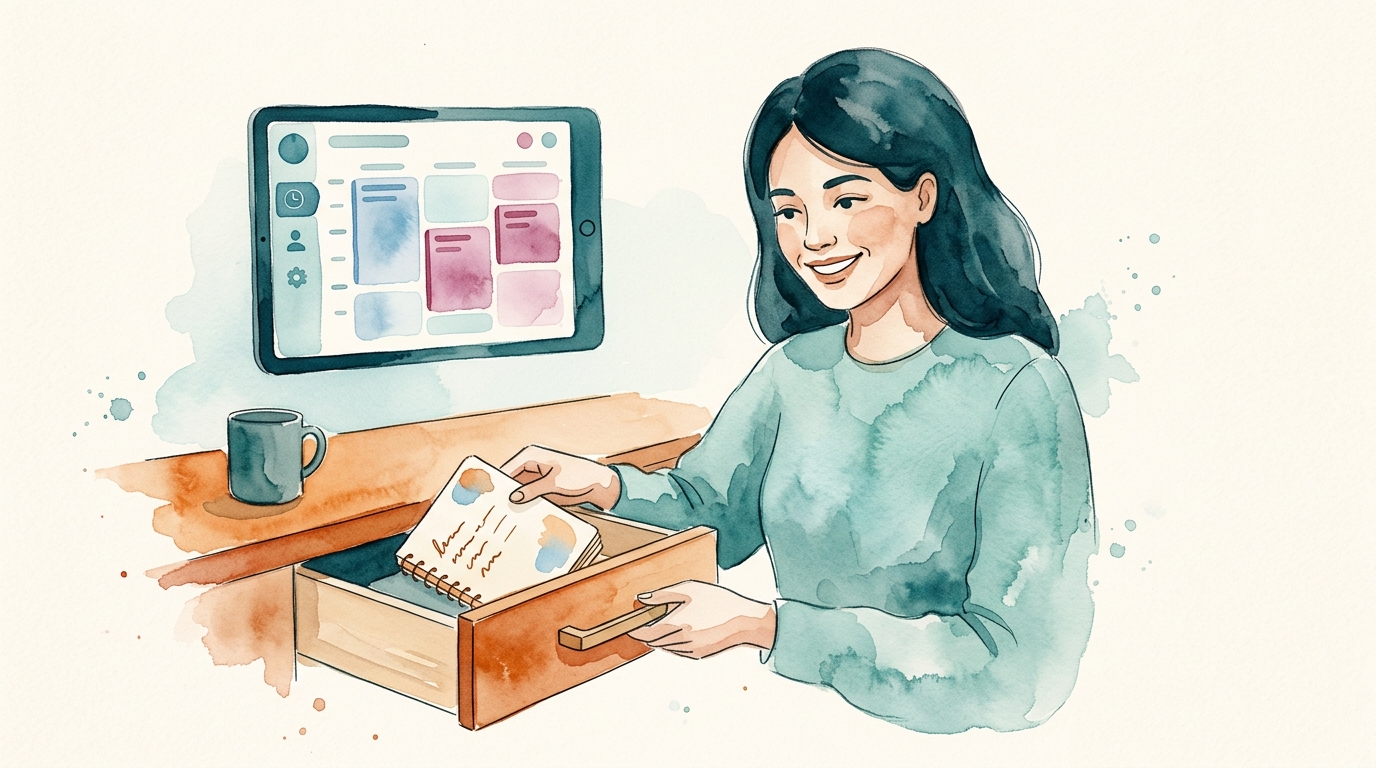
Open the top drawer at your front desk. Somewhere in it there is a spiral notebook, or a legal pad, or yesterday's printed schedule with pencil down the margin. Somebody on your team writes in it every day. It was supposed to be gone when you bought the software.
A few weeks ago I wrote about the software a practice bought and stopped using, and the last of four questions in that post was what you were doing before, and whether you are still doing it. It got one paragraph. This is the rest.
The oldest technology in the building
The ADA publishes a ten-point checklist for investing in technology. Question eight asks: "Can it be integrated smoothly with legacy technologies?" The text under it warns that "you may need to pass up an otherwise valuable technology simply because it will not relate well to other existing systems."
The checklist means machines and software, and it is right about them. But the oldest legacy technology in a dental practice is the notebook, and nobody asks a vendor whether the new product will relate well to it. It was never on the list of existing systems, because nobody thinks of it as one.
It is one. It has a user, a daily routine, and information that exists nowhere else in the building.
How to find them
You will not find these by asking whether the team uses the software. Everyone says yes, and everyone is telling the truth. The software is open on every screen.
Look instead for paper beside a keyboard. Sticky notes along the edge of a monitor. A spreadsheet open in a second window. A whiteboard in the sterilization area with names on it. Tally marks on a pad by the phone. Then ask each person one question: what do you write down?
The tally marks are worth a second look, because the ADA's own guidance depends on them. Its page on calculating return on investment tells a dentist to "fill in these blanks: my practice spent $X on marketing for the month and received Y new patient calls." Somebody has to produce Y. In a lot of practices Y is a row of pencil strokes kept by whoever remembers to make one, because the phone system can count calls and has no idea which callers were new. A post earlier this week walked through what a call log shows and what it cannot. The pad by the phone lives in that space.
Why it is still there
A by-hand process survives a software purchase for one of three reasons, and they call for three different responses.
Sometimes it is a backup, and it should be. The HIPAA Security Rule's contingency plan standard asks a practice for procedures to respond to "an emergency or other occurrence (for example, fire, vandalism, system failure, and natural disaster) that damages systems that contain electronic protected health information." The rule is about protecting that information, not about running the schedule. But it uses a phrase worth borrowing: establish the procedures and "implement as needed." A printed schedule for the morning the server is down is a sensible thing to own. A notebook that gets written in every day while the system is running fine is not a backup. Nothing is down.
Sometimes nobody decided to stop. The software does the job, the notebook does the same job, and both carry on because ending the notebook was never anybody's call. An earlier post on this blog was about naming one owner for each piece of software, with the authority to make decisions about it. This is the first decision that owner inherits. Until somebody is entitled to say the notebook is retired, it will not be, and your coordinator will keep entering everything twice out of loyalty to the patients on that page.
And sometimes the software does not do the job. This is the one worth slowing down for. The notebook holds something the software has no place for: which patients want a call if an earlier appointment opens, who needs the first slot of the day because of a ride, which lab case is running late and whose visit depends on it. In that case the notebook is not a failure of discipline. It is the most accurate account of what your practice needed, written by the person who needed it, and it is more specific than anything that was said in the demo.
What to do with each
If it is a backup, treat it like one. Label it, write down when it comes out, and put it away until then.
If nobody decided, decide. Sit down with the person who keeps it, not over her. Ask what would have to be true for her to trust the screen, and then run the software alone for a stretch and see what goes wrong. Whatever goes wrong is what the notebook was really for, and it moves the notebook into the next group.
If the software does not do the job, take the notebook to the vendor and say: show me where this goes. If there is an answer, you have found a feature nobody was trained on. If there is not, you have learned what the product is. Keep the notebook without apology, or go shopping with it in your hand. An earlier post argued that a trial exists to find out whether anyone will use a product. The notebook is how you tell. If it is still filling up at the end of the trial, the trial has answered you.
What you should not do is throw it away to make the purchase look successful. The person keeping that notebook is not resisting anything. She is making sure the people on that page get their call.
Where we come into it
We sell software, so the notebook is the first thing we would want to see. Laine answers the phone and books the appointment. Saige holds the practice's procedures where the team can find them. If what is in your notebook is something neither of them does, the honest answer is to tell you so, and we will.
It is month to month, with no long-term contract and no onboarding fee, so nothing obliges you to keep paying for a screen while the drawer does the real work. Bring the notebook to the demo.
Deren Flesher, DDS. Founder, AiroDental.
Frequently asked questions
- Why is my dental team still entering things twice?
- For one of three reasons. The paper is a backup for the day the system is down. Or the software does the job and nobody was ever entitled to retire the paper. Or the software does not do the job, and the paper is holding something it has no place for. The three look identical from across the room and call for different responses, so the first step is to ask the person who keeps it what she writes down and why.
- How do I find the by-hand processes in my practice?
- Not by asking whether the team uses the software; everyone does. Look for paper beside a keyboard, sticky notes along a monitor, a spreadsheet in a second window, a whiteboard with names on it, tally marks by the phone. Then ask each person one question: what do you write down?
- Is a paper backup required by HIPAA?
- The Security Rule's contingency plan standard asks for procedures to respond to an emergency or other occurrence, system failure included, that damages systems holding electronic protected health information, to be implemented "as needed." The rule is about protecting that information, not about how you run the schedule, and how it applies to your practice is a question for whoever advises you on compliance. The useful part for this purpose is the phrase "as needed": a backup comes out when something is down. A notebook written in every day while the system runs fine is doing some other job.
- What should I do if the software cannot do what the notebook does?
- Take the notebook to the vendor and ask to be shown where each thing in it goes. If there is an answer, you have found a feature nobody was trained on. If there is not, you have learned what the product is, and you can keep the notebook without apology or shop for a replacement with it in your hand.
- Should I make the team stop using paper?
- Not by decree. Sit down with the person who keeps it, ask what would have to be true for her to trust the screen, and run the software alone for a stretch to see what goes wrong. The person keeping that notebook is making sure the patients on that page get their call. Taking it away to make a purchase look successful removes the safety and keeps the problem.
Related articles

The Count
No practice closes the day on a feeling; the day sheet is set against the deposit. A software trial deserves the same habit. This post shows how to keep two columns, the task done in the tool and the task done the old way, who keeps them, and what to do when the count and the mood disagree.
October 16, 2026 · 6 min read
The Caller Who Tried Twice
"We must have been on the other line" is a guess, and patients can hear it. Once the scheduling coordinator has looked at the call log, she can say what actually happened, ask what the call was about, and find everyone else who tried twice and never made it to the counter.
October 14, 2026 · 5 min read

The Teenager Who Drove Himself
A seventeen-year-old with a license walks up to the counter by himself. May he be seen today, and who gets told what afterward? The first answer belongs to your state. The second is a federal rule most front desks guess wrong. Both belong on one page the doctor writes before he arrives.
October 12, 2026 · 7 min read