Lunch Is a Decision
November 4, 2026 · 7 min read
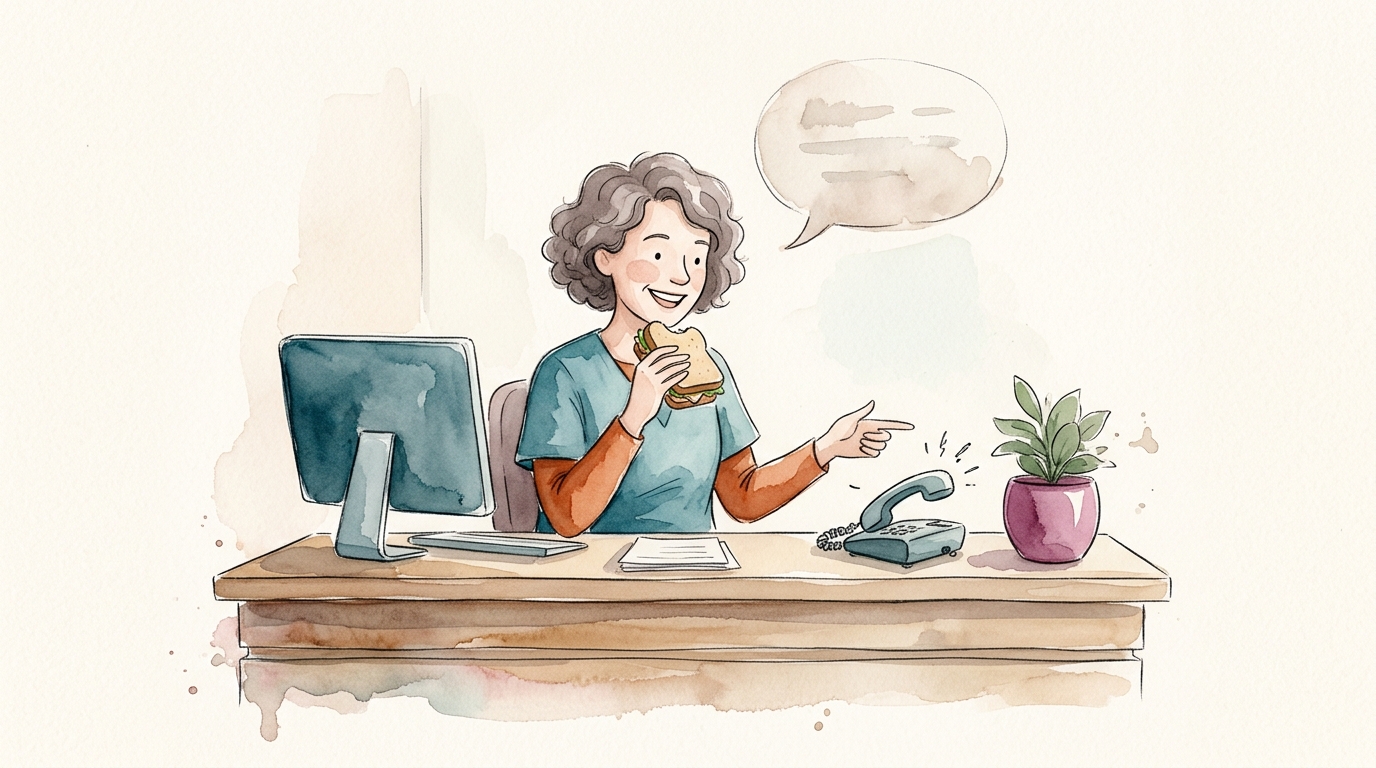
Somewhere in your office, in a drawer or a binder behind the front desk, there is an employee policy manual. The ADA publishes a checklist of what should be in one, and two of the items on it are an "Office Schedule" and "Lunch and Break Policies." Most manuals have both. The lunch page says when lunch is and how long it runs. The schedule page says what hours the office is open. Nowhere in either of them is there a sentence about what happens to the phone between the two.
That is not an oversight in the manual. It is the practice never having decided. The phone over lunch is handled by whoever is nearest, which some days is the scheduling coordinator eating at her desk, some days is the voicemail, and some days is nobody, because the ringer is down and everyone is in the break room. All three are answers. None of them was chosen.
The hour your patients have
The ADA's practice-management page on office hours gives one instruction that most of us already follow for the chair and almost none of us follow for the phone: "Try to match your office hours to the times the majority of your patients are able to come in." It goes on to suggest evening and weekend appointments "if possible to help schedule patients with limited availability." The page says nothing about lunch or the telephone. It does not have to. The logic carries on its own. A working adult who needs to call a dental office does it when she is not working, and for a lot of people that is the middle of the day.
A general dentist writing on the ADA's New Dentist blog in 2021, Dr. Sampada Deshpande, who notes an interest in a healthcare technology company, put it as plainly as anyone has: "I too, frequently make appointments for my chiropractor, personal physician and dentist during my lunch hour." Her advice to the reader was one sentence: "Make sure there is someone manning the phone at all times." She did not say who, or how, or whether that person was being paid to eat and answer at the same time. That is the part this post is about.
The hour your coordinator is owed
There is a federal rule about lunch, and it is older than most of the people reading this. It is a wage-and-hour rule, not a dental rule, and it says nothing about phones, patients, or offices like ours; whether it applies to a given team member on a given day is a question for your accountant or attorney, and state law may add to it. But it describes the lunch break better than any practice-management article does.
The Department of Labor's regulation on meal periods, 29 CFR 785.19, says that "Bona fide meal periods are not worktime," and then it says what makes one bona fide: "The employee must be completely relieved from duty for the purposes of eating regular meals." The next sentence is the one to read twice. "The employee is not relieved if he is required to perform any duties, whether active or inactive, while eating. For example, an office employee who is required to eat at his desk or a factory worker who is required to be at his machine is working while eating."
Required to eat at his desk is working while eating. Read that with a front desk in mind. The coordinator who takes her lunch at the counter because the phone might ring is, by the government's own example, not on a break. She is working, and the practice is either paying her for that hour or it is not, and in most offices nobody has asked which. "She grabs it if she can" is a decision the practice did not make, paid for by the person who made it.
What your own log already shows
You do not have to guess how many people call while the office is closed for lunch. Your phone system has a call history, and this blog has already walked through how to read it. Sort it by time of day. Look at the rows between the last morning appointment and the first afternoon one. Then look at what your system calls those rows, because, as the last platform post found, one system's "missed" is another's "abandoned," and a call that rang out while the team was in the break room may be sitting in a column nobody opens.
What you find will be your number, not a vendor's, and it will tell you whether lunch is a problem for your practice or a non-event. Either way, you will be deciding from something.
Deciding on purpose
There are two honest decisions and one dishonest one.
The first honest decision is that the phones are closed over lunch. If so, the greeting says when the office reopens, the voicemail says who returns messages and when, and someone owns that list the way someone owns the after-hours list. A closed phone with a true greeting is not a failure. A phone that rings into nothing is.
The second honest decision is that the phones are open over lunch, and a named person is covering them, on the clock, with her own lunch taken at a different time. Two coordinators can stagger. A solo coordinator cannot, and the owner who tells her "just keep an ear on it" has made the dishonest decision: the phone is open, nobody is paid to answer it, and the manual still says she gets a lunch.
Write down which one you chose. It goes in the manual, on the page that was missing it.
What the caller wanted
The lunch-hour caller wants one of two things. Some want information: are you open, do you take this plan, where do you park, did the claim go through. Some want an appointment, and the lunch hour is when they could finally make the call.
Laine, the AI receptionist in AiroDental, answers the inbound call during lunch the same way it answers the one that comes in after closing, in the caller's language, and more than ninety of them. For the caller who wants an appointment, it books the visit into Dentrix, Dentrix Ascend, Open Dental or CareStack, so the person who called at noon has a time on the schedule when the team comes back from lunch. For the caller who wants information the practice has written down, it gives that. For the caller whose question needs a person, a billing question about one account, say, it takes the message, and the team returns that call after lunch, on the clock. Laine does not place the call back; the coordinator does, with her lunch behind her.
That is the third honest decision, and it is the one that lets the manual's lunch page and the schedule page both be true at once. The coordinator eats. The phone is answered. The person who called during her own lunch hour gets a time, not a greeting.
There is no long-term contract and no onboarding fee. Hear Laine take the lunch-hour call.
Deren Flesher, DDS. Founder, AiroDental.
Frequently asked questions
- Should a dental office answer the phone during lunch?
- That is the practice's decision, and the point of this post is that it should be made on purpose rather than by whoever is nearest. The ADA's office-hours guidance says to match your hours to when the majority of your patients can come in, and the middle of the day is when many working adults can make a call. A practice can decide its phones are closed over lunch, with a greeting that says so and someone who returns messages, or open over lunch with a named person covering them on the clock. Either is honest. Leaving the phone to ring and hoping someone grabs it is not a decision.
- Can a dental receptionist eat lunch at the front desk and answer the phone?
- She can, and if she is required to, the federal meal-period regulation says she is working while eating. 29 CFR 785.19 says a bona fide meal period requires the employee to be "completely relieved from duty," and gives "an office employee who is required to eat at his desk" as its example of someone who is not. That is a wage-and-hour rule about whether the time is paid, not a rule about phones, and whether it applies to a given team member is a question for your accountant or attorney. The practical point is that "keep an ear on it" is a decision the practice is asking her to pay for.
- How do I know how many patients call my dental office during lunch?
- Your phone system's call history already has the answer. Sort it by time of day and look at the rows between the last morning appointment and the first afternoon one. Then check what your system calls those rows, because systems define "missed" and "abandoned" differently and a call that rang out while the team was at lunch may sit in a column nobody opens. The number you find is yours, not a vendor's.
- What should the voicemail say if the office closes for lunch?
- When the office reopens, and that messages are returned, by whom, and when. A closed phone with a true greeting is a decision; a phone that rings into a generic message is not. Someone on the team should own the lunch-hour messages the way someone owns the after-hours list, so the caller who tried at noon hears from a person that afternoon.
- How does Laine handle calls during the lunch hour?
- Laine, the AI receptionist in AiroDental, answers the inbound call during lunch the same way it answers one after closing, in the caller's language, and more than ninety of them. If the caller wants an appointment, Laine books it into Dentrix, Dentrix Ascend, Open Dental or CareStack, so the time is on the schedule when the team comes back. If the caller wants information the practice has written down, Laine gives it. If the question needs a person, Laine takes the message and the team returns the call after lunch. Laine does not place the call back; the coordinator does, with her lunch behind her.
Related articles
The Financial Policy Nobody Signed
The ADA's sample financial policy ends with one signature line that reads "Patient, guardian or guarantor signature." For an adult, the three words name one person. For a sixteen-year-old in the chair, they name three, and the one holding the clipboard is the one who will never pay the bill. The fifth and last post in the series on the adolescent patient: what the financial policy for a minor has to say, who presents it, to whom, and before which visit.
November 2, 2026 · 7 min read
Abandoned Is Not Missed
A patient says she hung up without leaving a message. Ask five phone systems what that call was and you get a missed call, an abandoned call, both at once, or a call in a category of its own. None of them is wrong. That is why every "practices miss this many calls" figure is one vendor's customers under one vendor's definition, and why the first job is reading your own system's sentence.
October 30, 2026 · 6 min read
The Voicemail You Leave
The email asking whether your voicemail is HIPAA compliant wants you to buy something. The federal answer has been public since 2002, and it fits on an index card: yes, leave the message, and limit it to your name, your number, enough to say which appointment, and a request to call back. The same answer covers the husband who picks up and the patient who asked you not to call the house. The rest is a sentence the doctor writes once.
October 28, 2026 · 6 min read